


You may also like
-

Bananas Poster
Ellen Isham Schutt · 1904 · Sunlit bananas botanical print with gentle shading and a clean, airy background
Poster from €9 · Framed from €16
-

Margarine Axa Poster
Leonetto Cappiello · 1931 · Bold Margarine Axa poster with striking figure, green backdrop, and sunny yellow highlights
Poster from €9 · Framed from €16
-

Cirkelkaffe Poster
J.Olséns · 1945 · Graphic coffee poster featuring a wide-brimmed hat figure before green countryside
Poster from €9 · Framed from €16
-

Ib Geertsen Poster
Ib Geertsen · 1982 · Vibrant geometric poster balancing bold primary blocks with crisp Scandinavian modernism
Poster from €9 · Framed from €16


-

"Very nice Posters. The quality is amazing and we received it very quickly !"
-

"A shop to visit absolutely. Huge selection of posters. We spent more than an hour there !"
-

"Perfect to find gift. Price are very good. An they can frame and pack it on site"


About the Artist
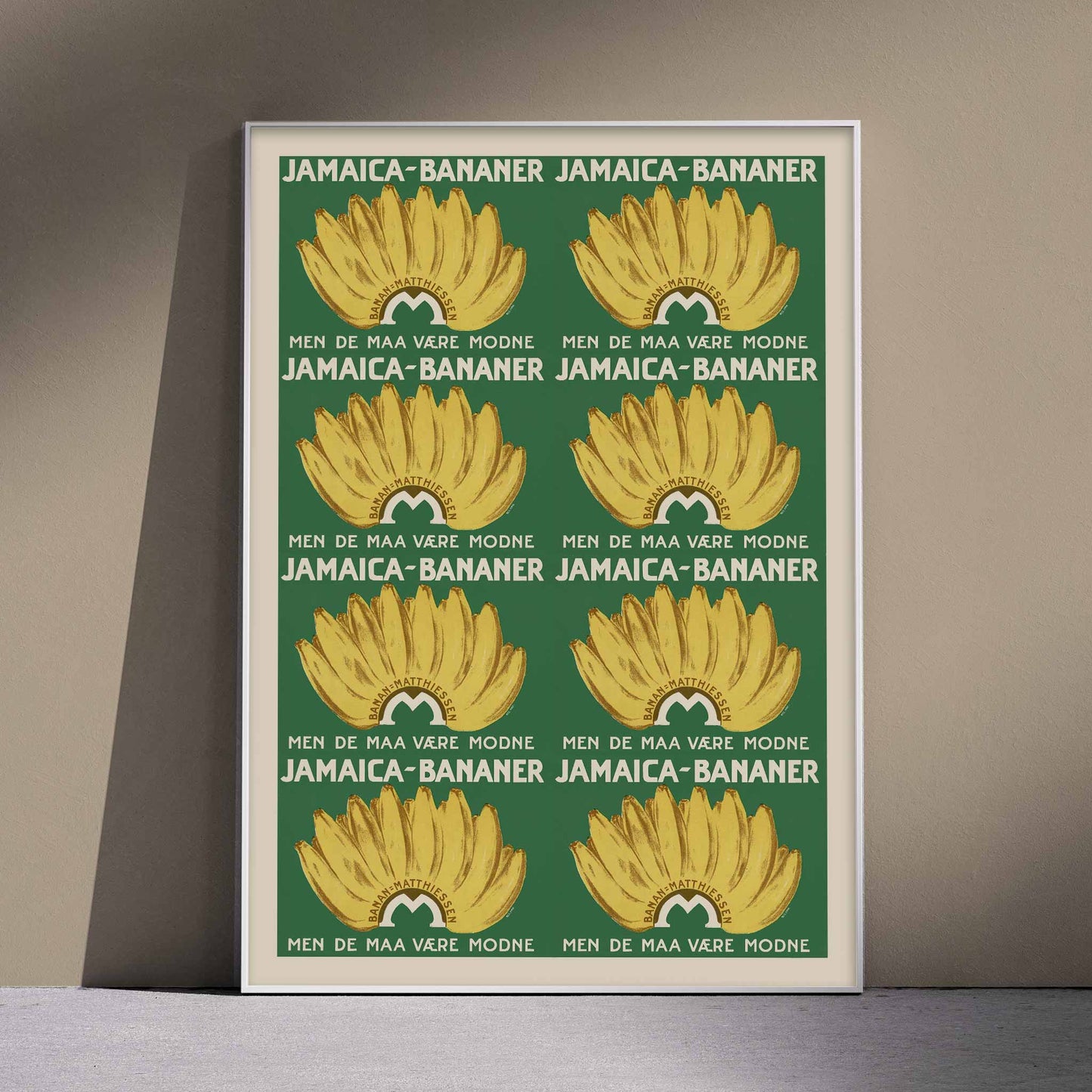
By an unknown artist, this 1920 advertisement turns Jamaica bananas into a direct promise for shoppers. The repeated product name and Danish wording MEN DE MAA VÆRE MODNE, meaning they must be ripe, keep attention on the condition expected at purchase. A small circular mark beneath each bunch adds authority to a named commercial message, even though no individual designer is credited. The sheet matters as a document of trade: it presents bananas as imported food with a clear place of origin and a simple standard of quality. Its period language preserves a Danish campaign. Today, this vintage wall art records interwar food commerce.
The Artwork
The campaign gave a familiar grocery decision a distant geography. By naming Jamaica, the advertiser made origin part of the buying message, while the repeated demand for ripeness set a clear expectation for the seller and customer. The wording suggests a practical sales purpose rather than a commemorative or purely decorative one. Bananas are presented as a reliable imported product, not as an exotic fantasy detached from everyday trade. That purpose gives the vintage print historical value: it preserves how food advertising addressed Danish consumers in 1920. Today, the art print records a specific link between overseas supply and the local grocery.
Style & Characteristics
Against a deep green field, eight golden banana bunches repeat in two even columns. Each cluster opens outward in curved fingers, with brownish linework defining the individual fruit and the stems. Cream lettering presses between the images, making the Danish message easy to read without breaking the pattern. The eye travels down one column, then across to its neighbour, following the same emblem beneath each bunch. Yellow dominates the vintage poster, while the green ground gives the colour a dense, leafy depth. A narrow beige border encloses the field. The flat ink and limited palette make the vintage print unmistakably period.
In Interior Design
In a sunlit kitchen, place this vertical poster above an oak breakfast table, where its tall proportions can draw the eye upward from the work surface. A simple black frame will echo the dark edge around the print without competing with the fruit. The green ground can answer a single potted herb, while the yellow bunches bring warmth to pale plaster. Because the lettering repeats across the sheet, the piece adds a measured graphic rhythm to a breakfast area rather than a purely decorative botanical note. This vintage poster links interior decoration with food culture near the place where bananas are stored.