


You may also like
-
Girl with a earing Poster
MORYARTY · 2022 · Matisse inspired portrait poster with blue background, white face, and yellow earring
Poster from €9 · Framed from €16
Regular price From €6,00Regular price -
The Dream Poster
Henri Matisse · 1960 · Vibrant sleeping figure poster with flowing contours and bold, flat color shapes
Poster from €9 · Framed from €16
Regular price From €6,00Regular price -
Papiers découpés 5 Poster
MORYARTY · 2023 · Colorful abstract faces poster built from crisp cut-paper shapes on a soft ground
Poster from €9 · Framed from €16
Regular price From €6,00Regular price -
Papiers découpés 4 Poster
MORYARTY · 1952 · Joyful cut-paper style abstract poster with bold red and blue shapes on beige
Poster from €9 · Framed from €16
Regular price From €6,00Regular price


-

"Very nice Posters. The quality is amazing and we received it very quickly !"
-

"A shop to visit absolutely. Huge selection of posters. We spent more than an hour there !"
-

"Perfect to find gift. Price are very good. An they can frame and pack it on site"


About the Artist
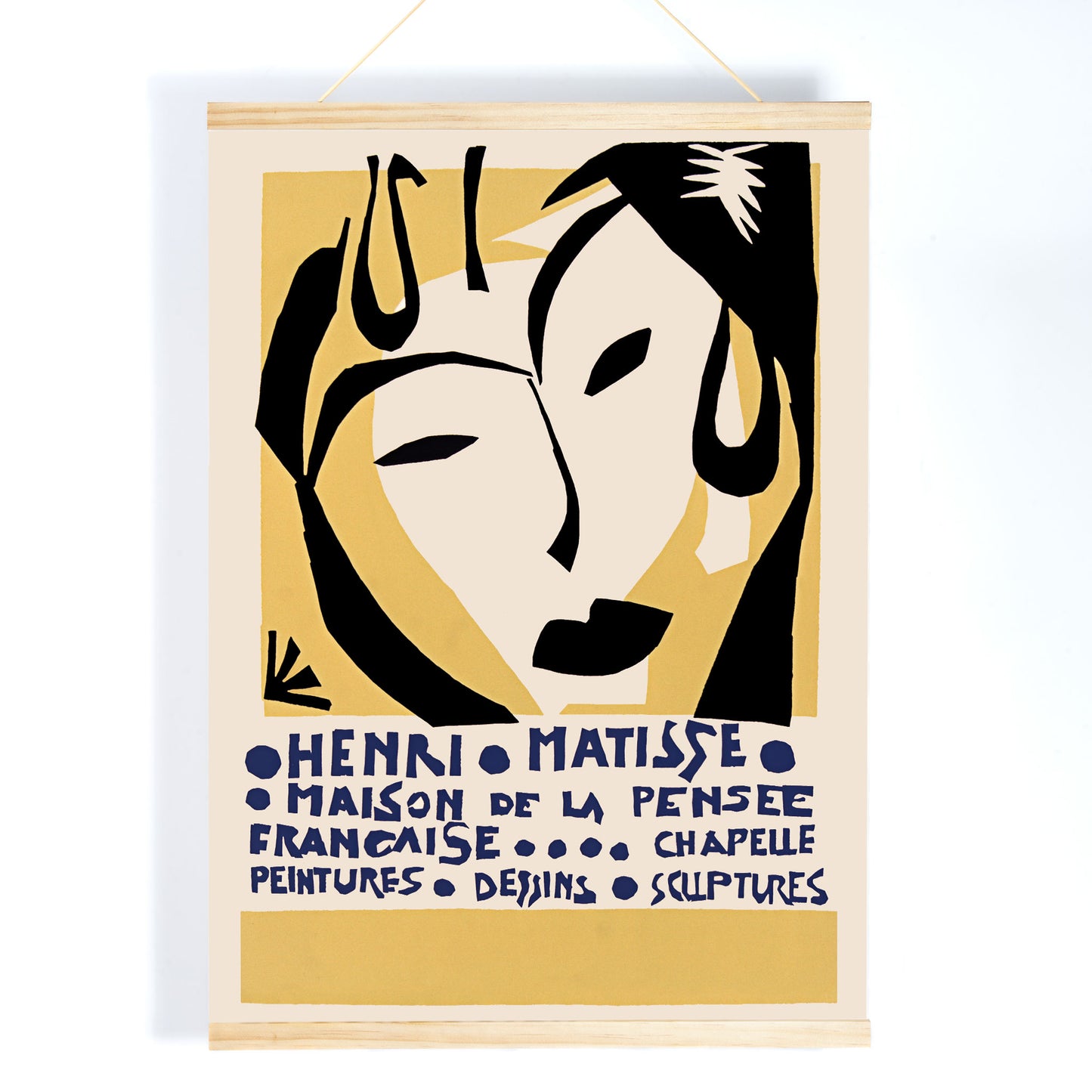
By 1950, Henri Matisse had turned limitation into a new kind of freedom. Working after illness made painting physically harder, he relied on scissors, painted paper, and large simplified shapes to keep his line alive. This Maison de la Pensée française poster brings that late language into a public announcement for Paris, where the artist's name becomes part of the exhibition itself. Printed by Mourlot, the art print carries Matisse's modern idiom into the world of cultural publicity and shows how his pared-back approach could still feel immediate on the street.
The Artwork
The poster was made to announce a 1950 exhibition in Paris under the Maison de la Pensée française banner, turning a temporary display into a visible cultural event. Rather than treating the notice as plain information, the design gives Matisse's identity a central place and lets the artist's reputation do part of the speaking. Mourlot's role in the printing links the piece to the city’s modern poster tradition, where fine art printmaking served galleries, institutions, and public life at once. Seen today, this vintage poster still reads as an exhibition invitation rooted in a specific postwar Paris moment.
Style & Characteristics
Black curves carve out the face, while flat fields of pale yellow and cream hold the image in a narrow vertical poster format. The eyes are reduced to slits, the mouth to a dark shape, and the surrounding marks feel cut rather than drawn, echoing Matisse's late paper compositions. Beneath the portrait, dense blue lettering and dots pack the lower register with a hand-made rhythm that contrasts with the spare face above. The result is bold wall art with a minimalist presence, where warm color and abrupt contour create a vivid vintage print for close viewing.
In Interior Design
Framed above a walnut console in a calm living room, this art print would draw the eye toward the wall without overwhelming the furniture below. The pale ground and dark linework suit home decor that uses natural wood, soft textiles, and a restrained palette, while the blue typography adds a measured graphic pulse. Because the composition leaves generous breathing room around the face, it can anchor interior decoration that favors one strong image over clutter. In that setting, the poster brings a clear sense of Parisian modernism to everyday space.